An equipment asset register is the verified list of every machine a condition monitoring service will cover, with its tag, location, hierarchy, nameplate data, criticality and measurement points, and it has to exist before any useful monitoring starts. Without it, data is collected against the wrong machines, alarms are set against guesses, and reports cannot be linked to work orders. For any condition monitoring service Indonesia plants depend on, the register is the first deliverable to agree.
This article is written for maintenance managers, reliability engineers and planners in Indonesian plants who are starting or restructuring a condition monitoring programme, or who are about to hand one to an external provider. It explains what a good equipment asset register contains, how it is built in the field, and how PT Tiara Vibrasindo Pratama (TVP) uses it as the starting point of its monitoring services.
Key Takeaways
- The equipment asset register is the backbone of a condition monitoring service: routes, alarm limits, reports and work orders all depend on it.
- A usable register goes beyond a tag list; it holds machine kinematics such as running speed, bearings, gear teeth and coupling type.
- A recognised taxonomy such as ISO 14224 keeps the hierarchy consistent across sites and makes failure data comparable.
- Field verification is non-negotiable; desk data from old drawings is frequently wrong about motors, bearings and drive arrangements.
- Criticality ranking should be attached to every register entry so that monitoring effort follows business risk.
- One system must own the master data, with a clear change process, or the register will drift out of date within months.
Why the Equipment Asset Register Comes First
Condition monitoring is a comparison exercise. A vibration reading, an oil sample result or a thermal image only means something when it is compared with a baseline, an alarm limit or the previous reading from the same point on the same machine. That comparison depends entirely on knowing exactly which machine the data belongs to and what that machine is.
When the equipment asset register is weak, the symptoms are predictable. Two pumps with similar tags are swapped in the route, so a trend shows a sudden jump that is really a different machine. A motor rewound to a different speed keeps its old record, so the analyst looks for bearing frequencies in the wrong place. A spare pump installed after a failure is never added, so it runs unmonitored until it fails as well.
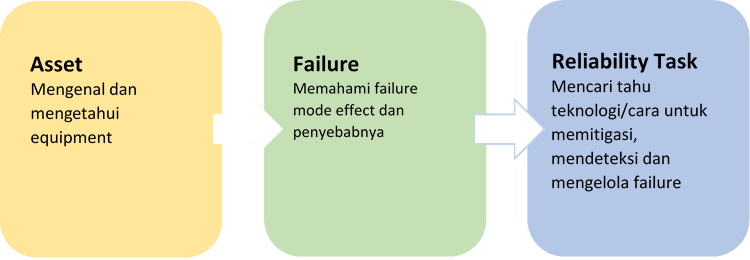
The general guidance in ISO 17359 on condition monitoring and diagnostics of machines starts with the same logic: identify the equipment, its function and its failure modes before choosing techniques and intervals. An equipment asset register is how that first step is recorded in a form that a monitoring team, a planner and a manager can all use.
Condition Monitoring Service Indonesia: What the Asset Register Must Contain
An equipment asset register for monitoring purposes carries more engineering detail than a typical financial or fixed asset list. The table below shows the fields TVP considers essential and why each one matters to the analysis.
| Field group | Typical fields | Why it matters for monitoring |
|---|---|---|
| Identification | Tag number, description, functional location, equipment class | Links every reading, report and work order to one physical machine |
| Nameplate | Manufacturer, model, serial number, power rating, voltage | Defines operating envelope and applicable severity limits |
| Kinematics | Running speed, bearing designations, gear teeth, impeller vanes, belt and coupling data | Needed to calculate fault frequencies in vibration spectra |
| Machine train | Driver, driven equipment, gearbox, mounting type, foundation | Determines measurement point layout and machine class |
| Lubrication | Lubricant type, sump volume, sampling point | Supports oil analysis routes and trend comparison |
| Criticality | Criticality rank, redundancy, safety and production consequence | Sets monitoring technique, interval and alarm priority |
| Measurement points | Point ID, location, direction, sensor type, units | Keeps data comparable from one survey to the next |
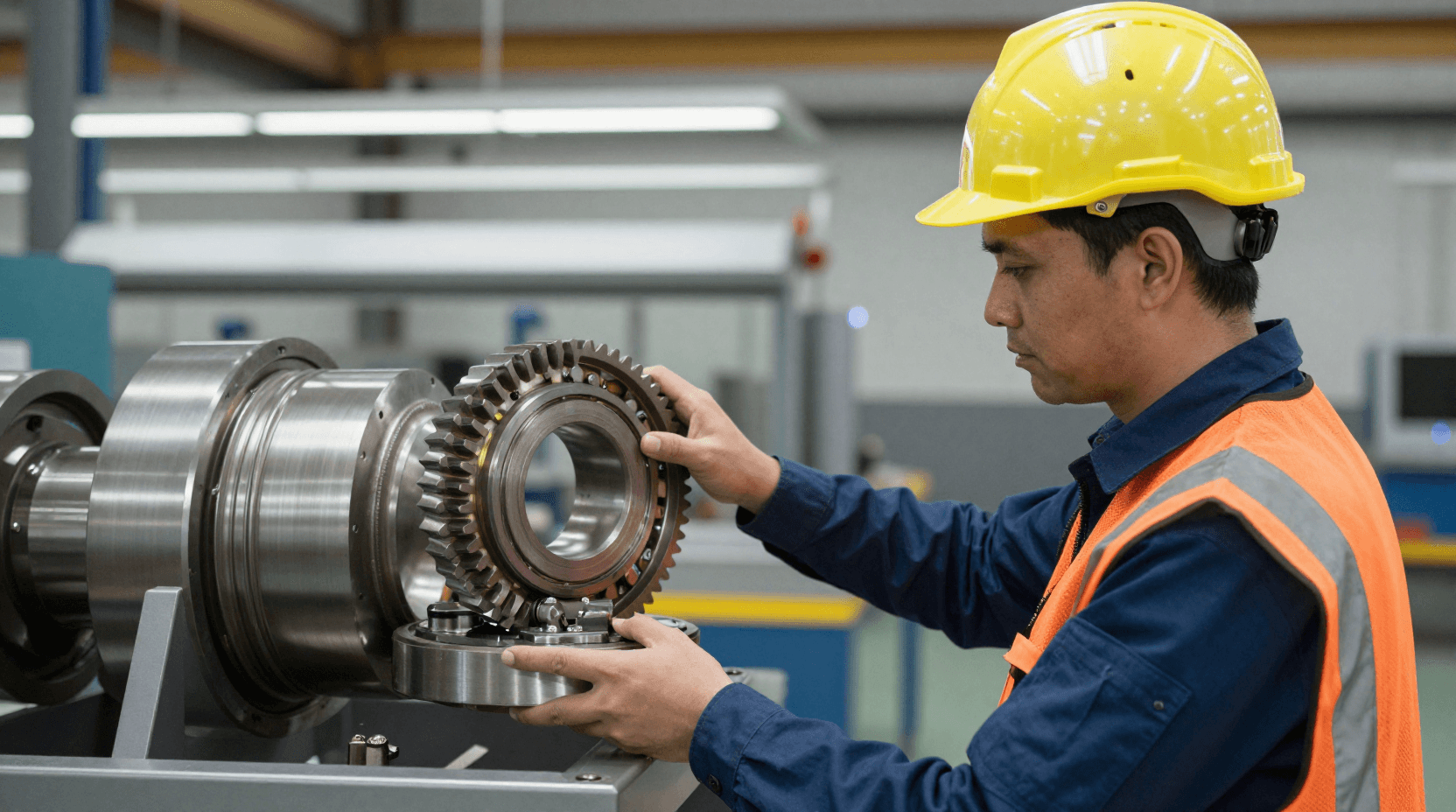
Kinematic data deserves special attention. For example, a motor running at 1,480 rpm has a running speed of about 24.7 Hz, and the defect frequencies of its bearings are multiples of that speed set by bearing geometry. If the register records the wrong bearing designation, the analyst may miss an outer race defect or flag a harmless peak as a fault.
Hierarchy and taxonomy
ISO 14224, the petroleum, petrochemical and natural gas standard for collecting reliability and maintenance data, defines a nine-level taxonomy. The upper levels describe use and location: industry, business category, installation, plant or unit, and section or system. The lower levels describe the equipment itself: equipment unit, subunit, component or maintainable item, and part. Even outside oil and gas, adopting this structure keeps an equipment asset register consistent and allows failure data from different sites to be compared.
How TVP Builds an Equipment Asset Register in the Field
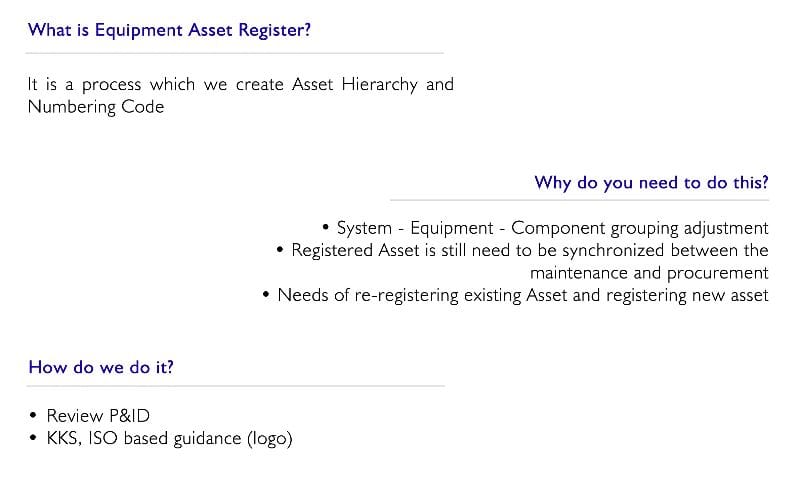
TVP’s Equipment Asset Register service belongs to the Life Cycle Strategy group of its services, alongside criticality ranking and planning work. The approach combines desk work with physical verification, because records alone are rarely reliable enough for monitoring.
- Collect existing data. CMMS exports, P&IDs, equipment data sheets, vendor manuals and previous monitoring databases are gathered and merged into one working list.
- Define the boundary. The client and TVP agree which systems and equipment classes are in scope, and where each machine boundary starts and ends.
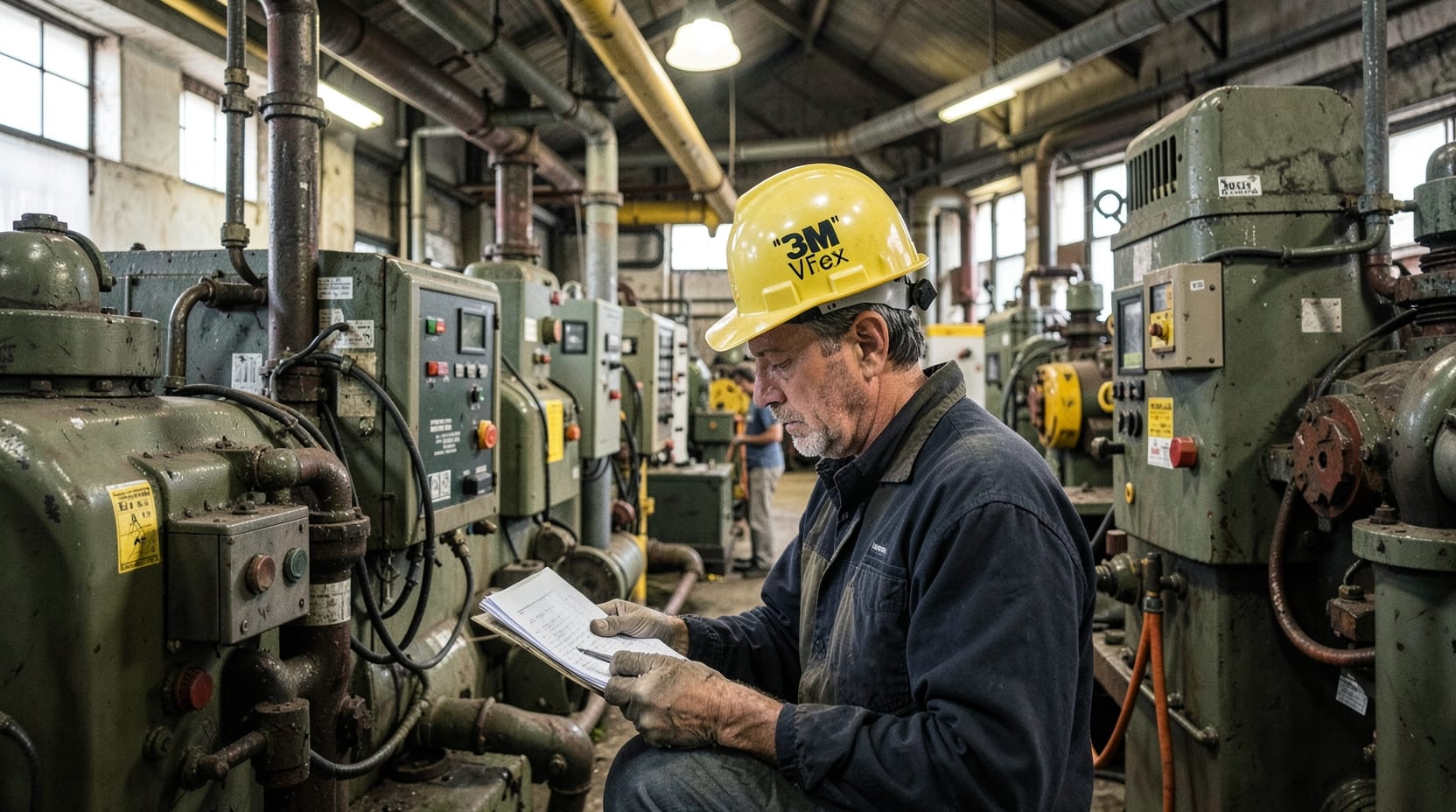
- Walk down the plant. Engineers verify each machine against its nameplate, photograph it, confirm the drive train and record anything that differs from the documents.
- Fill kinematic gaps. Bearing designations, gear data and vane counts are taken from manuals or, where safe and possible, confirmed during planned stops.
- Assign criticality. Each entry receives a criticality rank so that the monitoring strategy can follow risk.
- Define measurement points. Point names, positions and directions are set using a consistent convention, ready to load into the monitoring software.
- Hand over and govern. The verified register is delivered with a change procedure so that it stays accurate after the project ends.
The walkdown is where most of the value appears. It is common to find motors replaced with a different frame size, pumps re-impellered, standby units never recorded, and tags painted over. Each of these errors would otherwise flow straight into the monitoring database.
Linking the Equipment Asset Register to Criticality
Not every machine deserves the same attention. A register that lists 600 machines with no ranking leads to one of two failures: either everything is monitored at the same interval, which wastes effort on low-risk equipment, or the team quietly drops machines from routes without any agreed logic.
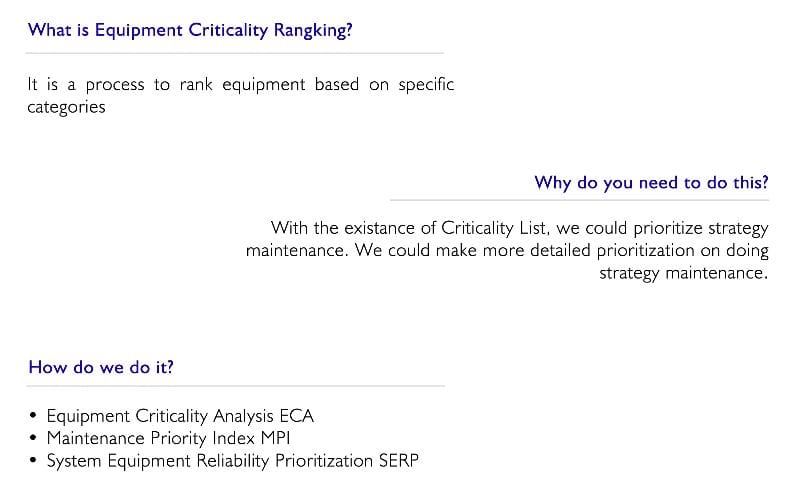
Attaching a criticality rank to each record solves this. TVP’s Equipment Criticality Ranking service assesses consequence and likelihood separately, then uses the result to allocate techniques and intervals. A typical outcome might look like this:
- High criticality, no spare: continuous online monitoring or a short route interval such as every 14 days, plus oil analysis and thermography where relevant.
- Medium criticality or spared: periodic route-based vibration every 30 days, with oil and thermal surveys on a longer cycle.
- Low criticality: operator inspection, or a route interval of 90 days, with escalation if a fault is suspected.
These intervals are illustrative; the right figure depends on the failure development time of each failure mode. The point is that the equipment asset register is where the decision is recorded, so the route builder, the analyst and the auditor all see the same logic.
From Equipment Asset Register to Monitoring Routes
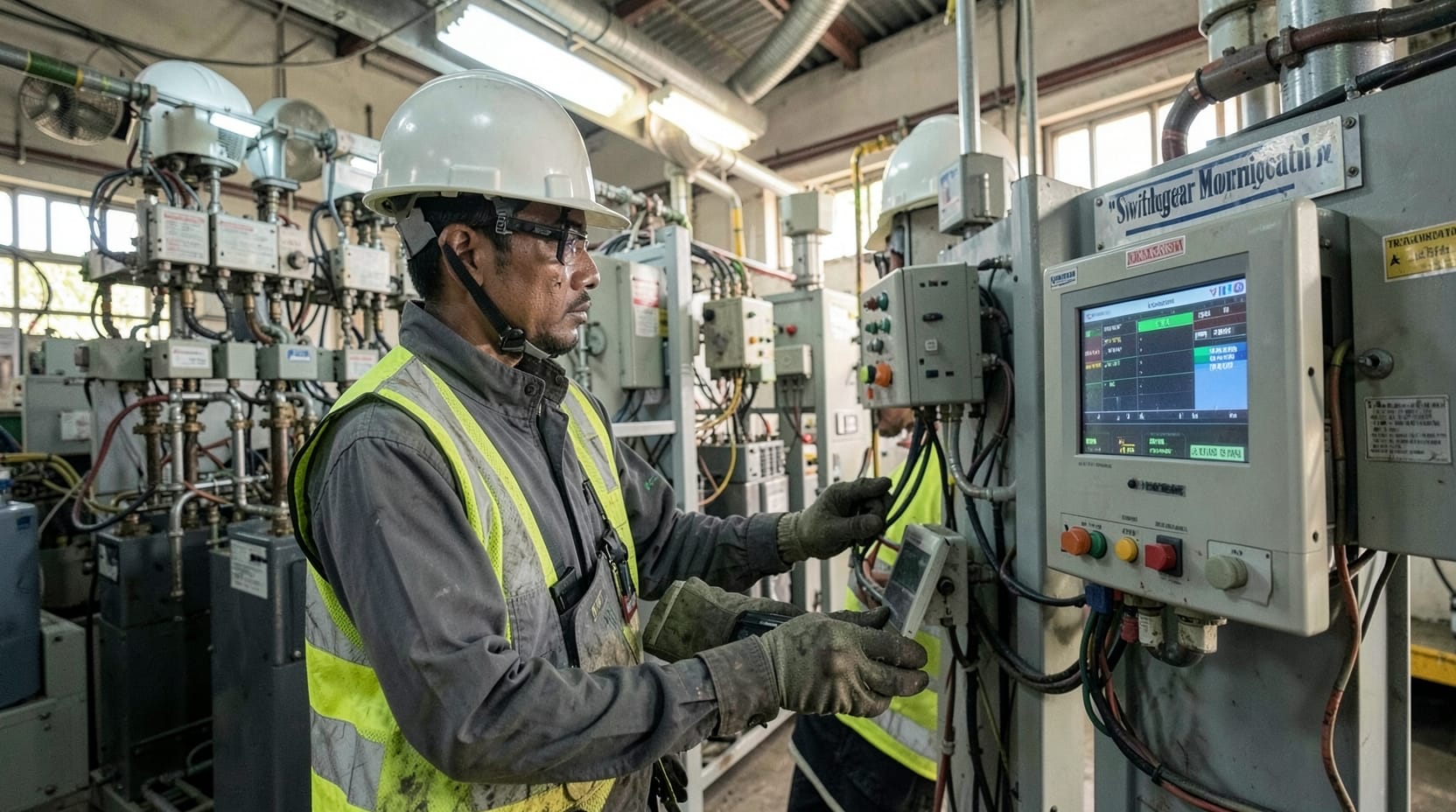
Once the register is verified, it becomes the source for the monitoring configuration. In route-based vibration programmes, machines are grouped by area and walking order; each machine carries its measurement points, and each point carries an alarm set and analysis parameters. Online systems use the same structure, with points mapped to sensor channels.

A clean equipment asset register makes this configuration fast and auditable. Analysis parameters can be set by machine class, for example a frequency range up to 1,000 Hz for velocity trending on standard motor-pump sets, with higher ranges and acceleration enveloping where bearing faults are a concern. When a new machine of the same class is installed, it inherits the template rather than being configured from memory.
TVP’s Condition Based Monitoring and Tiara Reliability Remote Monitoring (TRM) services both depend on this structure. In TRM, decisions on mitigating reliability risk are based on the Asset Wellness status of each critical asset, which is only meaningful when every status is tied to a verified register entry. Equipment-specific guidance, such as reliability technology for pumps, then determines which techniques are applied to each class.
Keeping the Equipment Asset Register Accurate
An equipment asset register is accurate on the day it is handed over and begins to decay the day after. Machines are replaced, motors are rewound, gearboxes are re-ratioed and new lines are added. Without governance, an equipment asset register that was 98% correct at handover can lose much of its value within a year or two.
Practical governance rules
- Name one owner for the master data, usually the CMMS administrator or reliability engineer, and one system of record for each field group.
- Connect management of change to the register: any change to rotating equipment must update the record before the job is closed.
- Ask route technicians to flag nameplate mismatches during every survey, and correct them before the next one.
- Audit a sample of entries every 12 months against the field, focusing on high-criticality machines.
- Track register quality as a key performance indicator, for example the percentage of critical machines with complete kinematic data.
Good governance also connects maintenance execution to the register. TVP’s Planning and Scheduling service relies on the same tag structure, so that a recommendation in a monitoring report becomes a work order against the correct machine, not a free-text note that someone has to interpret later.
Common Equipment Asset Register Problems and Fixes
Most equipment asset register problems are not technical. They come from unclear ownership, data copied between systems without a key, and a rush to start monitoring before the foundation is ready. The following problems appear repeatedly in plants starting a monitoring programme:
- Duplicate tags across systems. The CMMS and the monitoring software use different naming conventions. Fix: adopt the CMMS tag as the single key and map everything to it.
- Missing standby units. Spared machines are left out because they rarely run. Fix: include them, monitor them when in service, and record running status.
- Outdated kinematics. Bearings or speeds changed during repair but records did not. Fix: make the repair shop report part changes back to the equipment asset register.
- No boundary definition. It is unclear whether a motor belongs to the pump record or has its own. Fix: follow the ISO 14224 equipment unit and subunit logic.
- Register built without the field. Desk data is accepted without a walkdown. Fix: verify at least all critical machines physically before routes are finalised.
Each of these problems is cheaper to fix during the equipment asset register project than after months of data has been collected against the wrong record.
Where the Asset Register Fits in Asset Management
An equipment asset register is not only a condition monitoring tool. ISO 55001, the management system standard for asset management, expects an organisation to know what assets it has, what condition they are in and what risks they carry. A well-maintained register supplies the first part of that evidence; condition monitoring supplies the second.
The same register feeds a computerized maintenance management system, spare parts decisions, lifecycle cost analysis and capital planning. That is why TVP treats it as part of a wider integration of technology, business process and competency rather than a one-off data entry job. A monitoring programme built on a solid register tends to stay useful for years; one built on guesswork tends to be restarted.
TVP has delivered data-heavy monitoring work for many years. Its experience list includes projects such as Contract Service for PdM Data Acquisition at PT. Chevron Pacific Indonesia, where structured equipment data is the precondition for reliable data acquisition. More background on the discipline is available in the general overview of condition monitoring.
FAQ
What is an equipment asset register in a condition monitoring service?
It is the structured list of every machine the service will monitor, with a unique tag, location, hierarchy position, nameplate data, drive train configuration, criticality and the measurement points assigned to it. The equipment asset register is the reference that routes, alarm limits, reports and work orders all point back to, so it has to be built before the first measurement is taken.
How long does it take to build an equipment asset register?
It depends on the number of machines and the quality of existing records. A plant with a clean CMMS export needs mainly field verification, while a plant with outdated drawings needs a full walkdown. Plan the work in stages: critical equipment first, then the rest of the monitored population, so that monitoring can start on the assets that matter most while the register is completed.
Which data fields are mandatory?
At minimum: tag number, description, functional location, equipment class, manufacturer and model, running speed, power rating, bearing types, coupling and driven equipment, criticality rank, and the measurement points with their orientation. Without running speed and bearing data, a vibration analyst cannot calculate fault frequencies, so those two fields matter more than most.
Should the register live in the CMMS or in the monitoring software?
Both, with one master. The CMMS normally owns the functional location and tag hierarchy, while the monitoring software holds measurement points, alarm sets and machine kinematics. The tag number is the key that links them. Duplicating master data in two places without a defined owner is the most common cause of a register drifting out of date.
How often should the equipment asset register be reviewed?
Review it whenever a machine is replaced, re-rated or relocated, and audit the whole register at least once a year. Each management of change record that touches rotating equipment should trigger an update. A quick check during every route also helps: if the technician finds a nameplate that does not match the register, the discrepancy is logged and corrected before the next survey.
Conclusion
A condition monitoring service is only as good as the list of machines it is built on. A verified equipment asset register, structured with a recognised taxonomy, enriched with kinematic data, ranked by criticality and governed by a clear change process, turns raw readings into decisions that can be trusted and acted on. Building it first saves months of confused data later.
Talk to TVP. If you are planning a new monitoring programme or cleaning up an existing one, TVP can help you build and verify the equipment asset register before routes and alarms are set. Email info@tiaravib.com, call 021 5704200, or WhatsApp +62 821-1378-3727. Office: Jl. Penjernihan II No. 5A, Bendungan Hilir, Jakarta Pusat 10210.