Critical spare parts are the components a plant must be able to fit immediately when a failure happens, because waiting for procurement would cost more in downtime, safety or environmental risk than holding the part ever will. Deciding which parts qualify, and how many to keep, is a reliability question first and a warehouse question second. That is why spares sit inside asset reliability management, not only inventory control.
This article is written for maintenance managers, reliability engineers, planners and materials coordinators in Indonesian plants caught between production, which wants every part on the shelf, and finance, which wants inventory value to fall. It explains the method PT Tiara Vibrasindo Pratama (TVP) uses in its reliability services to settle that argument with evidence instead of opinion.
Key Takeaways
- Critical spare parts are defined by the consequence of not having them, not by their purchase price.
- Criticality must start from the asset: an equipment criticality ranking comes before any spares decision.
- Stocking levels for slow-moving spares should be calculated from failure rate, lead time and a chosen service level.
- Condition monitoring can replace some stock with early warning, but only when warning time is longer than lead time.
- Stored spares degrade; preservation and inspection are part of the decision, not an afterthought.
- A critical spares list is a living document that needs an annual review against real failures and consumption.
Why Critical Spare Parts Decisions Go Wrong
Most plants never designed their critical spare parts holding. It accumulated. Manufacturers supplied recommended spares lists at commissioning, and projects added capital spares. Every serious breakdown added a few more items. Years later the warehouse holds thousands of line items that have not moved in 2 years or more, while the part that actually stops the plant is still on a long-lead purchase order.

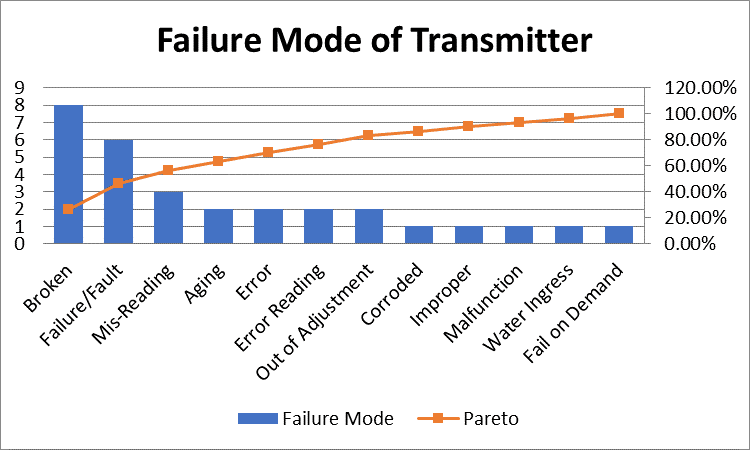
Three patterns appear again and again when TVP reviews spares holdings:
- Stock without a reason. Nobody can say which failure a part protects against, so nobody can decide whether it is still needed.
- Reasons without stock. The plant knows a failure mode is credible and costly, yet no spare is held because the item never appeared on any vendor list.
- Stock that will not work. The part exists in the system, but it is the wrong revision, it has been cannibalised, or it has been stored for years without preservation.
Each pattern has the same root cause: critical spare parts were selected one item at a time instead of being derived from a structured view of asset risk. That is why the method below starts with the equipment, not the warehouse.
Start With Equipment Criticality in Asset Reliability Management
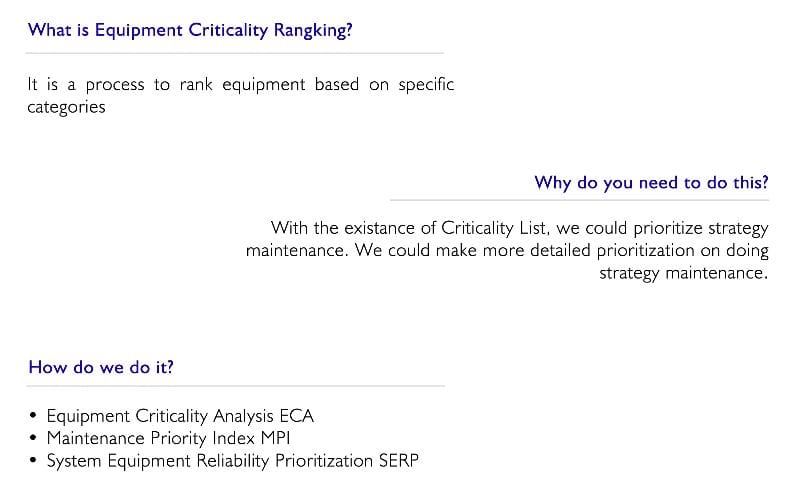
Critical spare parts can only be as critical as the asset they serve. Before any part is classified, the plant needs a ranked list of equipment based on the consequence of failure and the likelihood of failure, assessed separately. TVP delivers this as a dedicated equipment criticality ranking service, and it depends on a clean equipment asset register so that every tag, its parent system and its installed redundancy are known.
Installed redundancy matters more than anything else when screening critical spare parts. A pump with a running standby, automatic changeover and a proven start-up record does not need the same spares cover as a single-train gas compressor. The asset taxonomy in ISO 14224 is useful here because it forces a consistent breakdown from installation to equipment unit, subunit and maintainable item. Spares are linked at the maintainable-item level, which is exactly where failure modes live.
Once the ranking exists, detailed analysis of critical spare parts is worth doing for the top tier of equipment; lower tiers can follow simple rules.
A Method for Classifying Critical Spare Parts
With critical equipment identified, each candidate part is assessed on four questions. The answers decide whether it belongs on the critical spare parts list and which stocking strategy fits.

- Which failure mode does this part restore? If no credible failure mode needs it, it is not a spare; it is surplus.
- What is the consequence if the part is not available when that failure occurs? Use the same consequence categories as the equipment ranking: safety, environment, production and repair cost.
- How long does it take to obtain? Use the real lead time to site, including import clearance, inspection and transport to remote locations, not the catalogue figure.
- Is there a credible alternative? Options include an interchangeable part from another unit, a repair or reconditioning route, a vendor consignment stock, or a pooled spare shared between sites.
The result is a list of critical spare parts that maintenance, operations and finance can all read. The table below shows the classes TVP typically uses and how each one is managed.
| Class | Typical description | Stocking approach | Review trigger |
|---|---|---|---|
| Insurance spare | Rare failure, very high consequence, long lead time (for example a rotor or a large transformer bushing) | Hold one unit; preserve and inspect on a schedule | Asset change, sparing philosophy change, annual review |
| Critical operating spare | Credible failure on critical equipment, lead time longer than tolerable downtime | Stock level calculated from failure rate, lead time and service level | Stockout, consumption above forecast |
| Planned-replacement part | Consumed during scheduled overhauls or condition-based replacements | Order against the work plan; little or no permanent stock | Change in overhaul interval or scope |
| Non-critical part | Low consequence or short lead time, often with installed redundancy | Buy on demand or rely on supplier stock | Equipment re-ranked upwards |
The classification is recorded against the part and the failure mode, so the reason for holding critical spare parts is never lost again. TVP covers this workflow in its Reliability Centered Spare Part service and links it to broader material management so that the classification flows into reorder points and purchasing rules.
Calculating Stock Levels for Critical Spare Parts
For fast-moving consumables, classical inventory formulas work well. Critical spare parts behave differently: demand is low, irregular and driven by failures. A plant may use a part once every two or three years. The real question is the chance of needing more units than are held before replacements arrive.
A simple Poisson example
Assume a mechanical seal fails, on average, twice a year across the installed population, and the real lead time to site is 6 months. The expected demand during one lead time is therefore 1 unit. If failures occur randomly, a Poisson model gives the probability of covering all demand during the lead time for each stocking level:
- Stock 1 unit: about 73.6% probability of no stockout during the lead time.
- Stock 2 units: about 92.0%.
- Stock 3 units: about 98.1%.
This is an illustrative calculation, but the pattern matters: the second unit buys a large reduction in risk, the third much less, and a fourth mostly adds inventory value. The plant chooses the service level based on the consequence class, so a seal on a non-redundant critical compressor might justify 98% while a seal on a spared pump might be satisfied with 74%.
Where the inputs come from
The model is only as good as its inputs. Failure rates should come from the plant’s own work order history where it is reliable, supplemented by industry data such as ISO 14224-based databases when local history is thin. Where failures show wear-out behaviour rather than random occurrence, a Weibull analysis of time-to-failure gives a better forecast than a constant rate. Lead time for critical spare parts must be measured from requisition to the part being ready on site; for many Indonesian locations sea freight and inter-island transport add 3 to 6 weeks.
Classical concepts such as safety stock still apply, but they need adapting. For critical spare parts the “safety” is not against variable usage; it is against a failure the plant cannot afford to wait for.
Condition Monitoring as an Alternative to Stock
Some failures give warning. A rolling-element bearing usually develops detectable defect frequencies in a vibration spectrum weeks or months before it fails. Oil analysis can show wear metals rising long before a gearbox seizes. When the warning time is reliably longer than the procurement lead time, the plant has a choice: hold the part, or order it when the condition monitoring programme detects the defect.
That choice can release a share of critical spare parts inventory, but it is easy to get wrong. The conditions below should all be true before a part is moved from “stock” to “order on detection”:
- The failure mode is detectable by a technique that is actually applied to that asset, at an interval shorter than the warning period.
- The demonstrated warning time, not the theoretical one, exceeds the lead time with margin.
- Alarms are reviewed and acted on promptly, with a defined response route to purchasing.
- The supplier can genuinely deliver within the assumed lead time.
TVP’s Asset Wellness Analysis services, including vibration, lubricant analysis and electrical testing, supply the evidence for this decision. TVP’s Tiara Reliability Remote Monitoring (TRM) programme bases mitigation decisions on the asset wellness status from PdM technology examination, which is exactly the information a spares decision needs. Where repeated failures distort consumption data, a bad actor analysis should come first, because removing the cause of a chronic failure changes the spares requirement more than any inventory model can.
Storage, Preservation and Readiness
A part that cannot be fitted when needed is not a spare. Critical spare parts often sit for years, and Indonesia’s humid tropical climate is hard on stored equipment. Common problems include corrosion on machined surfaces, moisture in motor windings, brinelling of bearings in shafts that are never rotated, and elastomers that age past their shelf life.
A sound preservation programme for critical spare parts typically covers:
- Controlled storage for sensitive items, such as dehumidified rooms for electrical spares.
- Periodic rotation of spare rotors and shafts, for example a quarter turn every 3 months, to avoid bearing and shaft damage.
- Shelf-life tracking for seals, gaskets, belts and lubricants.
- Insulation resistance checks on stored motors and generator components before issue.
- Configuration control, so the spare matches the current revision of the installed equipment.
Each task belongs in the maintenance plan with an owner and an interval. Any of the critical spare parts that fails its readiness check should be treated as a stockout risk and escalated.
Justifying the Critical Spare Parts Budget
Finance teams rarely object to critical spare parts that are clearly justified. They object to holding value they cannot connect to risk. A structured list solves that by showing, for each item, the failure it protects against, the consequence avoided and the calculated stocking level.
The same logic supports reductions: surplus stock, parts for retired equipment and items now covered by condition monitoring can be disposed of with confidence. The conversation shifts from “cut inventory by a fixed percentage” to “hold what the risk requires, and nothing else”, which is a position both maintenance and finance can defend. For plants planning a broader availability improvement, the spares analysis also feeds a reliability, availability and maintainability study, where repair time including spares delay is a direct input.
Asset management frameworks such as ISO 55001 expect this kind of traceability: decisions about resources should be linked to asset risk and organisational objectives. A documented critical spare parts process is one of the easiest places to show it.
Building Competence in Spares Analysis
Methods only stick when people inside the plant can apply them. TVP’s integrated approach combines technology, business process and competency: software holds the data, the process defines how critical spare parts decisions are reviewed, and people need the skill to challenge vendor lists.
For teams that want to build that capability, TVP runs a Reliability-Centered Spare Part course alongside its consulting service. A practical approach is to analyse critical spare parts for one pilot area with TVP consultants, then let the plant team extend the same templates to remaining equipment.
FAQ
What makes a spare part critical?
A spare is critical when its absence during a failure would cause an unacceptable consequence: lost production, a safety or environmental risk, or a repair that cannot wait for normal procurement. Price does not decide it. A cheap seal on a single-train compressor can be more critical than an expensive spare motor for a pump that has an installed standby. Criticality comes from the asset’s role, the failure mode and the lead time together.
How many critical spare parts should we hold?
Enough to cover the demand expected during one replenishment lead time at the service level you have chosen. For slow-moving parts, a Poisson model using the failure rate and lead time gives the probability of a stockout for each stocking level. Most plants find that one or two units of a critical spare cover a very high share of risk, while extra units add cost faster than protection.
Should insurance spares be included in inventory reduction targets?
They should be reviewed, but not cut by a blanket percentage. Insurance spares exist for rare, high-consequence failures, so they will always look idle on a turnover report. Judge each one against the consequence it protects, its true lead time and its storage condition. Remove the ones whose original reason no longer applies, and keep the rest outside turnover targets.
How does condition monitoring affect spare part stocking?
Condition monitoring converts some sudden failures into planned replacements. When a reliable technique gives warning longer than the procurement lead time, the part can often be ordered on detection instead of being stocked. That only works when monitoring coverage, alarm response and supplier lead times are proven in practice, so the decision should be recorded per part and reviewed after every missed detection.
How often should a critical spares list be reviewed?
Review it at least once a year and after any event that changes the risk picture: a new asset, a change in sparing philosophy, a supplier exit, a stockout or a failure the list did not anticipate. The annual review should compare actual consumption and failures with what the list assumed, then adjust stocking levels, storage requirements and reorder points where the evidence shows a gap.
Conclusion
Critical spare parts deserve the same engineering discipline as the equipment they protect. Start from equipment criticality, link every part to a failure mode, calculate stock from real lead times and failure rates, use condition monitoring where warning time allows, and keep stored parts ready to fit. Done this way, the spares budget becomes a risk decision the whole organisation can explain, and general background on spare part management becomes a plant-specific plan.
Talk to TVP. If you want a structured review of your critical spare parts, email info@tiaravib.com, call 021 5704200, or WhatsApp +62 821-1378-3727. Office: Jl. Penjernihan II No. 5A, Bendungan Hilir, Jakarta Pusat 10210.