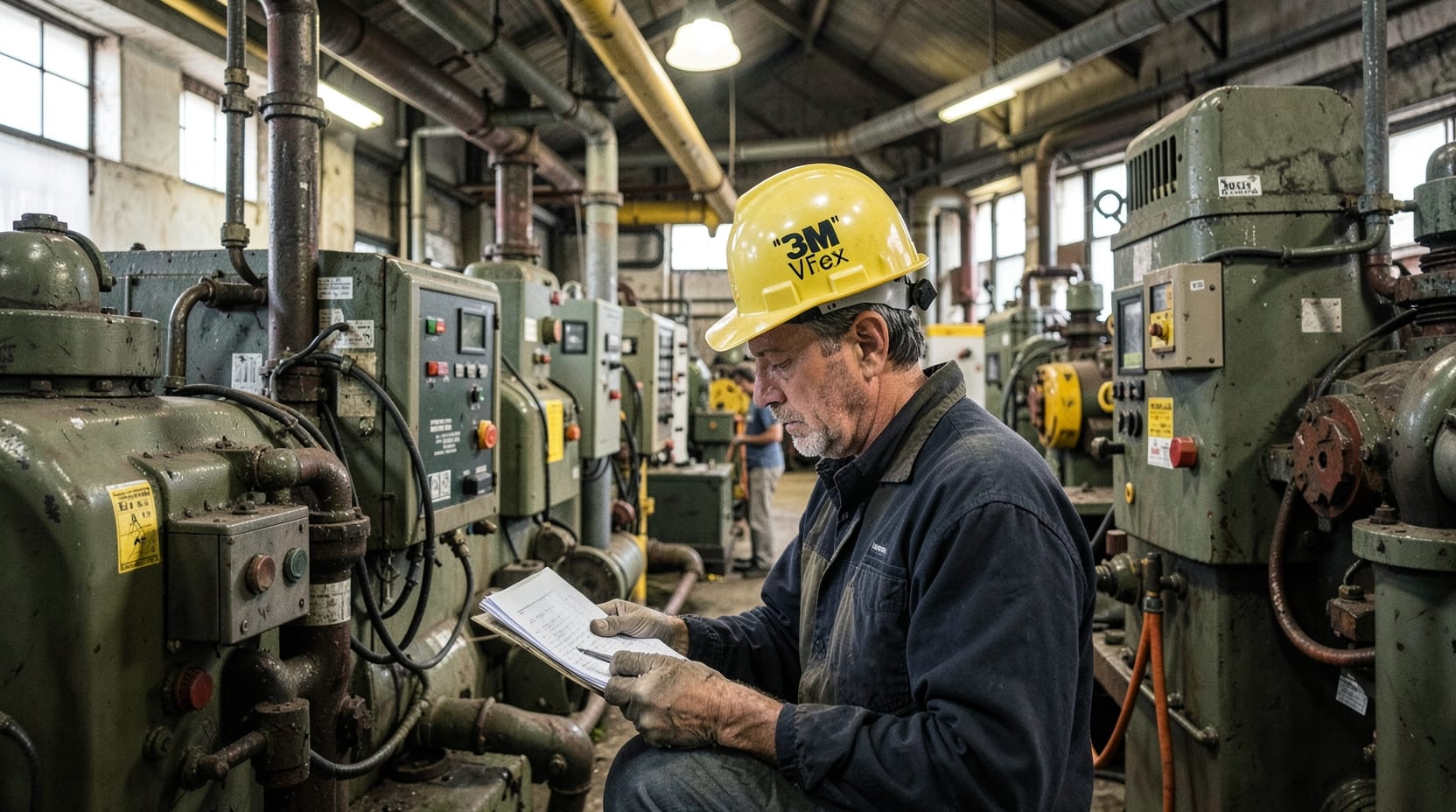
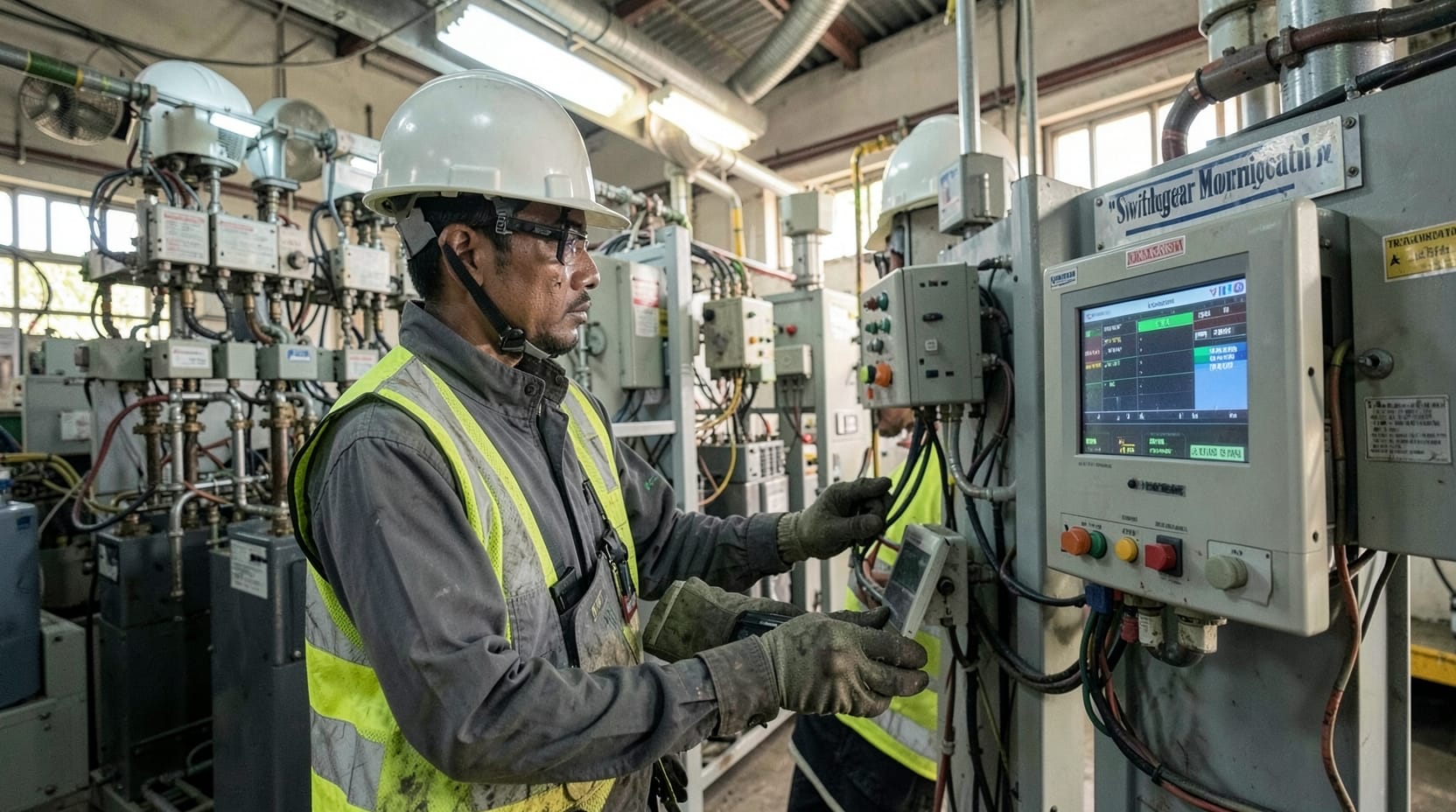
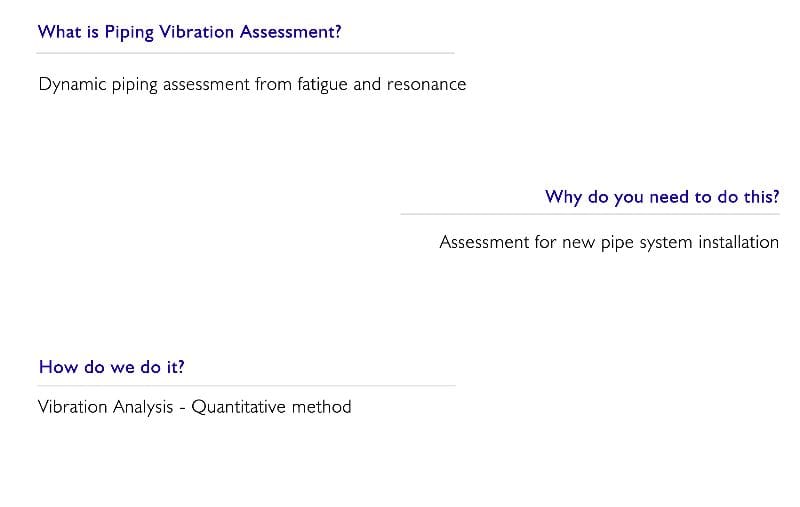
A piping vibration assessment tells you which process lines are at risk of vibration induced fatigue, what is driving the vibration, and which fixes will remove the risk at the lowest cost. It is the fastest way to stop small bore connection failures, flange leaks and cracked welds from repeating. It extends the vibration analysis Indonesia plants already run on machines to the pipework connected to them.
This guide is for plant engineers, integrity engineers and maintenance managers in Indonesian facilities that operate compressors, pumps and high-flow process pipework. It explains how PT Tiara Vibrasindo Pratama (TVP) approaches a piping vibration assessment, from screening to measurement and remedial design, and what you should expect to receive at the end of the study.
Key Takeaways
- Vibration induced fatigue is a leading cause of process pipework failures, and small bore connections are the most common failure point.
- A piping vibration assessment starts with screening, so measurement effort is focused on the lines with the highest likelihood of failure.
- Visible movement is not the same as high stress; the assessment judges risk by dynamic stress at welds and fittings.
- Finding the excitation source, such as pulsation, flow turbulence or machine vibration, matters more than adding supports blindly.
- The Energy Institute AVIFF guidelines provide a recognised, step-by-step method for screening and assessment.
- The deliverable should be a ranked action list with clear priorities, not just a table of vibration readings.
Why Piping Vibration Causes Failures
Process pipework is designed mainly for pressure, temperature and static loads. Dynamic loads from vibration are often treated only in general terms during design, and they can change completely when flow rates, gas composition or machine operating points change later in the plant’s life.

When a pipe vibrates, every weld and fitting sees a cycling stress. Even a modest stress range, repeated millions of times, can start and grow a crack. This is material fatigue, and it is particularly dangerous because there is often little warning before a through-wall crack releases process fluid. A line vibrating at 25 Hz completes more than 2 million stress cycles in a single day of operation.
The weak points are well known. Small bore branch connections, typically DN50 (2 inch) and smaller, such as vents, drains, instrument tappings and sample points, carry a concentrated mass like a valve on a short, stiff stub. When the main line shakes, the connection acts like a cantilever, and the stress concentrates at the weld to the main pipe. That is why a piping vibration assessment always looks at small bore connections as a separate population.
Vibration Analysis Indonesia: Common Excitation Mechanisms
Effective remedies depend on knowing what is driving the vibration. The AVIFF guidelines from the Energy Institute list several excitation mechanisms, and a piping vibration assessment checks which ones apply to each line.
| Excitation mechanism | Typical source | Typical signature |
|---|---|---|
| Flow induced turbulence | High velocity flow, bends, tees, reducers | Broadband, mainly low frequency |
| Mechanical excitation | Vibration transmitted from pumps, compressors and fans | Running speed and its harmonics |
| Pulsation from reciprocating machines | Reciprocating compressors and pumps | Multiples of running speed, strong discrete peaks |
| Flow induced pulsation | Vortex shedding at dead legs, side branches and relief valves | Discrete frequency linked to flow velocity |
| High frequency acoustic excitation | Pressure reducing valves and relief systems with large pressure drop | High frequency, usually above 500 Hz |
| Momentum changes | Fast valve closure, pump start and trip | Transient shock rather than steady vibration |
| Cavitation and flashing | Control valves and pump suctions in liquid service | Broadband noise with impulsive content |
The table is a simplification, but it shows why one remedy does not fit all problems. Adding a support may solve mechanical excitation, yet it can move a natural frequency closer to a pulsation frequency and make things worse. Resonance between a pipe span and an excitation frequency is behind many severe cases, and it is only found by measurement and analysis.
How TVP Carries Out a Piping Vibration Assessment
TVP’s Piping Vibration Assessment service is part of its Field Engineering and Analysis group. Each piping vibration assessment follows a staged approach, so that effort and cost grow only where the risk justifies it.
- Scope and data review. Process conditions, line lists, isometrics, P&IDs, support drawings and the failure history are reviewed with the client’s engineers.
- Screening. Each system is assessed qualitatively and then quantitatively for likelihood of failure, following the AVIFF method, so that high-risk lines are identified on paper first.
- Visual survey. Engineers walk the selected lines, looking for shaking, worn or missing supports, fretting marks, unbraced small bore connections and heavy valves on short branches.
- Vibration measurement. Velocity and acceleration are measured at defined points along the lines and on small bore connections, usually at several operating conditions.
- Analysis. Spectra and time waveforms are used to identify frequencies, link them to sources and check for resonance.
- Stress evaluation where needed. For lines that remain uncertain, dynamic strain measurement or a finite element model is used to estimate the stress range at critical welds.
- Recommendations. Remedies are designed and ranked, with a clear split between online fixes and those that need a shutdown.
Measurement practice
Most piping vibration of concern sits at low frequencies, often within the range of 2 Hz to 300 Hz, although acoustic excitation can be much higher. Measurements are taken in three directions at each point, and the operating condition is recorded at the same time: flow, pressure, temperature and machine load. Without that context, a reading taken at 60% load cannot be compared with one taken at full throughput.
Where a line moves visibly or its behaviour is hard to interpret from single points, operating deflection shape testing shows how the whole span moves at a given frequency. TVP also teaches this technique through its Operating Deflection Shape (ODS) for Machinery Troubleshooting course.
Small Bore Connections in a Piping Vibration Assessment
Small bore connections deserve their own step because they fail far more often than main lines. A typical piping vibration assessment finds many unbraced connections with heavy valves, flanges or instruments mounted on long stubs, often near reciprocating machines or high-velocity flow.
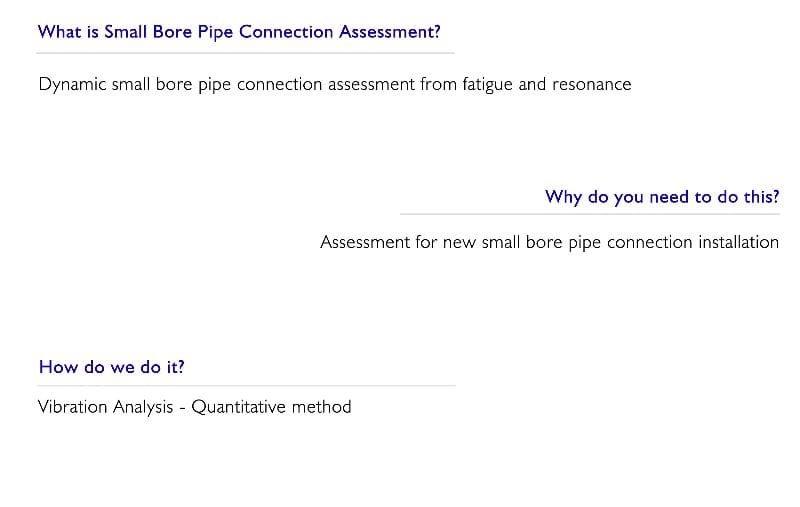
TVP’s Small Bore Pipe Connection Assessment evaluates each connection by its geometry, mass, location and the vibration of the parent pipe. The common fixes are simple and inexpensive:
- Bracing the connection back to the main pipe in two planes, so the branch and main line move together.
- Reducing the overhung mass, for example by removing redundant valves or using lighter fittings.
- Shortening the stub or increasing its wall thickness to raise its natural frequency.
- Removing unused connections entirely during a planned stop.
Because these fixes are cheap compared with a leak of hydrocarbon or steam, bracing at-risk small bore connections is often the first action recommended at the end of a piping vibration assessment.
Pulsation and Reciprocating Machinery
Reciprocating compressors and pumps produce pressure pulsations at multiples of running speed. For example, a compressor running at 600 rpm has a running speed of 10 Hz, and a double-acting cylinder produces strong pulsation at 20 Hz and its harmonics. When these pulsations meet a pipe span or a gas column with a matching natural frequency, the shaking forces can be large.
API 618, the standard for reciprocating compressors in petroleum, chemical and gas industry services, defines design approaches for pulsation and mechanical response. Existing installations, however, rarely match their original design study after years of operating changes. TVP’s Pulsation & Mechanical Vibration Analysis and Reciprocating Engine and Compressor Analysis services look at the machine and the pipework as one system, which is usually where the answer lies.
Typical pulsation remedies include orifice plates at selected flanges, changes to pulsation bottles or dampers, and support changes that move mechanical natural frequencies away from the main excitation orders. Each option is checked so that solving one frequency does not create a problem at another.
Flow Induced Vibration and Structural Response
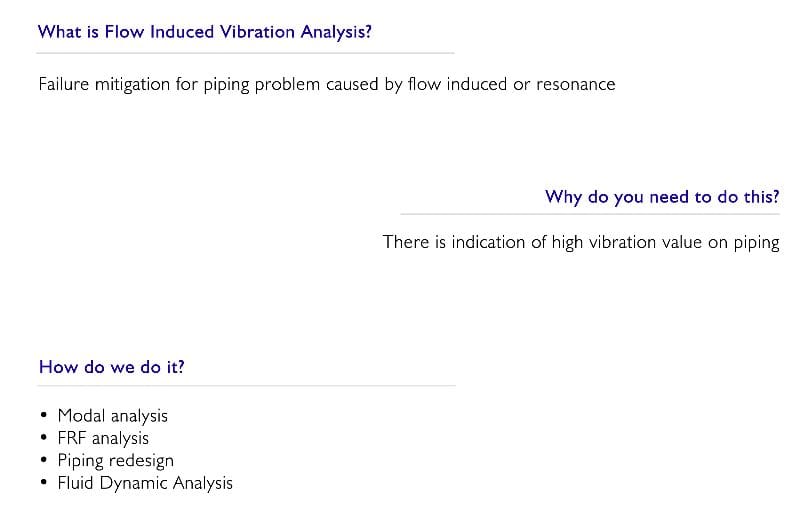
Not all piping vibration comes from machines. High flow velocity through bends, tees and partly open valves generates turbulence that excites the pipe, and dead legs or side branches can produce vortex shedding at a discrete frequency. These problems often appear after debottlenecking, when the same pipework carries more flow than it was designed for.
TVP’s Flow Induced Vibration Analysis examines these mechanisms, while Dynamic Structural Analysis looks at how the pipe racks, supports and structures respond. A support that looks solid on a drawing may be flexible in practice, for example a long cantilever bracket or a support resting on a vibrating platform. Measuring the structure as well as the pipe avoids fixing the wrong element.
When to Commission a Piping Vibration Assessment
Many plants only call for a piping vibration assessment after a leak. A better approach is to treat certain events as triggers, because each of them changes the dynamic loads on the pipework in ways the original design did not consider.
- After a fatigue failure. One cracked small bore connection usually means similar connections nearby are at risk as well.
- Before and after debottlenecking. Higher flow raises turbulence and can shift pulsation frequencies.
- When machines are added, replaced or re-rated. A new compressor speed or pump impeller changes the excitation the pipework sees.
- When operators report shaking or noise. Field observations are an early and inexpensive warning.
- Ahead of a major turnaround. A piping vibration assessment carried out a few months before a shutdown lets supports, bracing and orifice plates be installed during the stop.
For facilities with many compressors and long gas lines, a periodic piping vibration assessment, for example every 3 years or after each significant process change, keeps the risk register current. The interval is a planning decision rather than a rule, and it should follow the failure history and the number of operating changes in each unit.
Timing also affects cost. Measurements taken during normal production show the real excitation, while modifications are cheapest when they can be prepared in advance and installed in a planned window. Linking the piping vibration assessment to the turnaround calendar is therefore one of the simplest ways to get more value from the study.
What a Piping Vibration Assessment Report Should Contain
The value of a piping vibration assessment is in its decisions. A good piping vibration assessment report gives management a clear picture of risk and gives the maintenance team a list of jobs it can plan.
- A line-by-line summary of screening results and which lines were measured.
- Measured vibration and, where evaluated, estimated dynamic stress, with the operating conditions at the time.
- The identified excitation mechanism and any resonance found.
- Ranked recommendations with sketches for bracing and support changes.
- A split between actions that can be done online and those that need a shutdown.
- Advice on follow-up measurement after modifications, to confirm the fix worked.
Re-measuring after modifications is essential. A fix that reduces vibration by 70% at one point may shift energy elsewhere, and only a follow-up check confirms that the risk has actually gone. Compressor-specific guidance on reliability technology for compressors can then be used to keep the system under periodic surveillance. For background reading on the physics, see the general overview of vibration.
FAQ
What is a piping vibration assessment?
A piping vibration assessment is a structured study that identifies which pipework is at risk of vibration induced fatigue, measures the vibration on the lines that matter, finds the excitation source and recommends practical fixes. It covers main lines and small bore connections, and it ends with a ranked list of actions rather than a set of raw readings.
When should a plant request a piping vibration assessment?
Typical triggers are a fatigue crack or leak at a small bore connection, visible shaking after a process change, new or relocated compressors and pumps, debottlenecking that raises flow rates, and complaints from operators about noise or movement. A screening study is also worthwhile before a major turnaround, so that supports and bracing can be corrected while the unit is down.
Is high piping vibration always dangerous?
No. Visible movement does not automatically mean high stress, and small movement can still be dangerous at a stiff connection. What matters is the dynamic stress at welds and fittings compared with fatigue limits. That is why a piping vibration assessment combines screening, measurement and, where needed, strain or stress evaluation before deciding on any modification.
Which guidelines are used for piping vibration?
The most widely used reference is the Energy Institute Guidelines for the Avoidance of Vibration Induced Fatigue Failure in Process Pipework, often called the AVIFF guidelines. For reciprocating compressor systems, API 618 sets requirements for pulsation and mechanical design. Plant engineering standards and the original piping design code are also taken into account.
Can a piping vibration problem be fixed without a shutdown?
Sometimes. Adding clamps, bracing a small bore connection or changing an operating point can often be done online under a permit. Changes to pulsation dampers, orifice plates or major supports usually need the line isolated. A good assessment separates the actions that can be done now from those that must wait for a planned stop.
Conclusion
Vibration induced fatigue is predictable and preventable. A staged piping vibration assessment screens the plant, measures the lines that matter, identifies the real excitation source and turns the findings into ranked, practical fixes, with small bore connections treated as a priority. Done before a turnaround, it lets the most important modifications be made while the unit is already down.
Talk to TVP. If your plant has a history of small bore failures, visible pipe shaking or new compressor and pump installations, TVP can scope a piping vibration assessment for your facility. Email info@tiaravib.com, call 021 5704200, or WhatsApp +62 821-1378-3727. Office: Jl. Penjernihan II No. 5A, Bendungan Hilir, Jakarta Pusat 10210.