Remote Monitoring Center for Online Condition Monitoring Indonesia
Direct answer (AEO): A remote monitoring center is a staffed diagnostic facility that receives continuous data from permanently installed sensors on your plant equipment and converts that raw stream into triaged, interpreted advice. In an online condition monitoring Indonesia deployment, the center is the layer that most projects underestimate: instrumentation gets the budget, but interpretation is what determines whether a rising bearing signature becomes a planned work order or an unplanned outage. Tiaravib operates remote monitoring through its TRM (Total Reliability Monitoring) service, in which vibration, temperature, speed, and process signals from remote assets are reviewed by qualified analysts against baselines and trends, and alarms are escalated with severity classification rather than passed through raw.
Need a remote monitoring center partner in Indonesia? Contact Tiaravib — email info@tiaravib.com or WhatsApp +62 821-1378-3727.
At a Glance
- What it is: a staffed diagnostic center that receives continuous data from remote plant assets and issues interpreted, severity-classified recommendations.
- What arrives: vibration (overall and spectral), bearing temperature, winding temperature, speed, load, and process signals such as pressure and flow.
- What leaves: alarms with diagnosis and recommended action window, periodic trend reports, and a prioritised watch list.
- Hardware split: field instrumentation and data acquisition live on site; analysis software, historical database, and specialists live in the center.
- Latency target: for escalating alarms, minutes to hours — not days; routine trend reporting is weekly to monthly.
- Typical scope: 10 to 200+ measurement points across rotating, electrical, and process assets.
What a Remote Monitoring Center Actually Does
The phrase “online condition monitoring” is often used to describe hardware: sensors mounted on a bearing housing, a cable run to a junction box, a data acquisition card in a cabinet. That hardware is necessary but inert. A remote monitoring center supplies the three capabilities that turn a data stream into reliability value.
Continuous data reception and validation
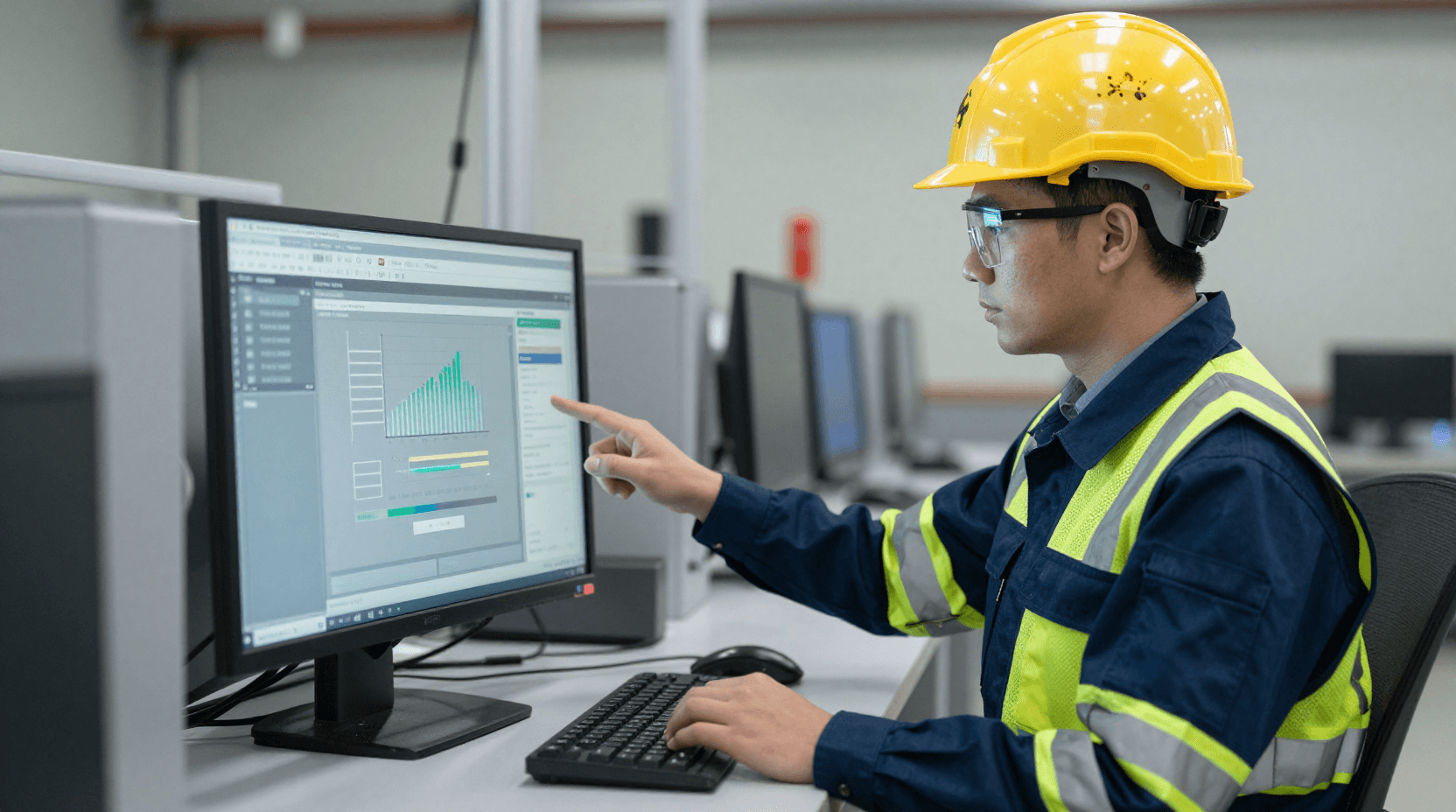
The center maintains a live connection to the site’s acquisition systems and verifies that data is arriving, timestamped, and physically plausible. Sensor dropouts, saturated channels, and drifting DC offsets are caught at the center rather than discovered months later when a trend line is found to be flat. Data validation is unglamorous and it is the single most common reason that an in-house monitoring installation quietly stops being trusted by the maintenance team.
Interpretation by qualified analysts
Software can detect that a value crossed a threshold. Software cannot decide that the threshold was crossed because the machine moved from 70 to 95 percent load, or that a sideband pattern indicates a developing bearing defect rather than a gear mesh harmonic. The center places a qualified vibration analyst — a Category II or higher practitioner in the ISO 18436 framework — on the data. That analyst compares each measurement against a machine-specific baseline, against ISO 10816 / ISO 20816 zone boundaries, and against the machine’s own history.
Severity classification and staged escalation
Every alarm leaving the center is classified. A practical scheme uses four levels: informational (note for the next report), watch (trend weekly, no action yet), alert (plan intervention within a defined window), and critical (act now, consider controlled shutdown). The classification tells the maintenance planner how urgently to act, which is the decision the raw data never makes on its own.
Why Interpretation Is the Real Bottleneck in Online Condition Monitoring Indonesia
Indonesian industrial sites have adopted online monitoring quickly, and the hardware market is mature. The binding constraint is analyst capacity and continuity. Three patterns recur.
Installation without ownership. A site buys a monitoring system, populates it with a few hundred points, and assigns interpretation to a rotating engineer who already carries a full workload. Within a year the alarms are being acknowledged rather than investigated, and the system’s credibility decays. Once the team has been burned by false alarms, genuine warnings are discounted too.
Thresholds copied from the template. Most platforms ship with default alarm limits. A default broadband vibration limit applied to a slow-speed agitator, a high-speed compressor, and a cooling tower fan will produce a mixture of nuisance alarms and missed detections. Useful alarms come from per-machine baselines established from the machine’s own normal operating envelope.
No closed loop to work management. A recommendation that does not reach the maintenance planning system is not a reliability action. The center’s output must land in a format the planner can schedule — a work request with a machine tag, a diagnosis, a recommended window, and a required skill set.
Anatomy of a Remote Monitoring Deployment
| Layer | Location | Typical content | Owned by |
|---|---|---|---|
| Sensing | Machine | Accelerometers, velocity probes, RTDs, proximity probes, tachometers | Site |
| Acquisition | Field cabinet | DAQ modules, multiplexers, edge gateway, temporary buffer | Site |
| Transport | Site to center | Managed VPN or secure tunnel over site internet, redundant cellular backup | Shared |
| Storage | Center | Time-series historian, spectral archive, machine register, event log | Center |
| Analysis | Center | Trending, spectral and envelope analysis, orbit and shaft centreline plots | Center |
| Human review | Center | Qualified analyst review, diagnosis, severity classification | Center |
| Escalation | Center to site | Alert, report, work request, callout for critical events | Shared |
The layer boundary matters commercially. Sites reasonably want to own the sensing and acquisition hardware, because it is a capital asset inside their fence. The storage, analysis, and human review layers are where the specialist skill sits, and that is the layer worth contracting.
TRM: Total Reliability Monitoring as a Managed Center Service
Tiaravib’s approach to remote monitoring is packaged as TRM, a managed monitoring service in which the site retains its instrumentation and the center supplies the diagnostic layer. In practice a TRM engagement runs through four phases.
Phase 1 — Asset criticality and point selection
Not every machine deserves continuous monitoring. The selection starts from an equipment criticality ranking so that measurement points are concentrated on assets whose failure stops production, creates a safety exposure, or has a long lead time for spares. A plant with 400 rotating machines might sensibly monitor 40 of them continuously and route the rest through periodic data collection.
Phase 2 — Baseline capture and alarm setup
Each monitored machine is run through its operating envelope and the resulting signature defines normal. Alarm levels are then derived from that baseline, adjusted for ISO zone boundaries where a standard applies. This phase typically takes four to eight weeks of settled operation, and it is the phase that determines whether the alarm philosophy is trusted for years afterwards.
Phase 3 — Routine surveillance and reporting
Once baselined, the center reviews data on a defined cadence. The output is a periodic report listing each machine’s status, the points in watch or alert state, the trend direction, and any diagnosis reached. A monthly report for a typical package runs to a machine-by-machine table plus a narrative section on developing issues.
Phase 4 — Escalation and diagnostic support
When a machine reaches alert or critical, the center escalates directly. For critical events this means a call to the site, an initial diagnosis within hours, and a second-opinion review by a senior analyst. Where a fault is confirmed and the signature is ambiguous, the center can deploy field diagnostic instruments — a portable analyser, an operating deflection shape study, or a run-up/coast-down test — to resolve the mechanism before recommending an intervention.
What the Site Receives Each Month
The deliverables should be specified in the contract, because “monitoring service” can mean anything from hourly data hosting to full diagnostic consulting. A workable TRM scope produces the following.
- A machine status dashboard covering every monitored point, with the current alarm state and the change since the last period.
- A prioritised exception list containing only the machines needing attention, each with a diagnosis, a severity, a recommended action, and a recommended window.
- Trend plots for each point in watch, alert, or critical state, covering at least the last twelve months where history exists.
- A work-request feed formatted for the site’s planning process, with machine tag, symptom, probable cause, and required skill.
- An engineering review meeting, monthly or quarterly, where the centre’s analyst walks the reliability team through the developing issues.
- Ad-hoc diagnostic reports for events that required deeper analysis than the routine cycle provides.
Connectivity and Data Security in Indonesian Plants
Plants are often remote, and internet reliability varies. A pragmatic design accepts this and does not depend on a perfect link.
The acquisition layer buffers locally, so a dropped connection delays data arrival without losing it. High-bandwidth data such as raw waveforms can be stored at the edge and pulled on demand rather than streamed continuously; the center usually needs spectral data continuously but raw time waveforms only around events. A redundant transport path — typically the site internet as primary with a cellular modem as backup — handles the common case of a single link failing.
On security, the standard pattern is outbound-only connectivity from the site. The field gateway initiates the connection to the center, so no inbound port is opened into the plant network. Data in transit is encrypted, and access to the historian is role-based, with the site able to audit who viewed which machine data. For sites operating under a corporate IT security policy, this design is usually approved without a lengthy exception process.
When a Remote Monitoring Center Is Worth the Cost
The economics are straightforward once the alternative is stated honestly. Continuous monitoring is justified when the consequence of an unplanned failure is large relative to the monitoring cost, or when the failure mechanism develops faster than the periodic route can catch it.
Suitable cases include machines on continuous process duty where a trip causes a plant-wide upset; assets with long-lead spares where a failure consumes months of delivery time; machines whose failure mode gives only days or weeks of warning; and equipment in areas that are difficult, hot, or unsafe to route routinely. It is a poor fit for cheap, redundant, fast-swap assets where a spare is on the shelf and changeout is a shift’s work.
As a reference point on cost structure, the instrumentation and installation are a one-off capital cost, while the diagnostic service is recurring. The recurring portion is the one that keeps delivering value, and it is deliberately priced so that monitoring a handful of critical machines remains affordable.
Standards and Frameworks the Center Works To
The centre’s recommendations are anchored in recognised standards so that severity judgements are defensible rather than personal opinion. Vibration severity bands follow ISO 10816 and its successor ISO 20816 for machine classes; measurement procedures and instrumentation requirements follow ISO 2954 and ISO 13373; analyst competence is graded under ISO 18436-2; and where a site is managed under an asset management system, the monitoring programme feeds ISO 55001 evidence of a controlled, risk-based approach to asset care. The Institute of Asset Management publishes the framework that many Indonesian asset owners reference when they formalise that evidence. Where a specific machine has no applicable standard, the centre falls back to the machine’s own established baseline, which is the more defensible reference in any case.
The U.S. Department of Energy‘s operations and maintenance guidance describes how centralised condition data supports maintenance and energy decisions at plant level.
Network and data integrity expectations for industrial monitoring infrastructure align with the cybersecurity framework maintained by the National Institute of Standards and Technology.
The International Electrotechnical Commission publishes the industrial communication and automation standards that underpin interoperable monitoring architectures.
Key Takeaways
- A remote monitoring center is a diagnostic service, not a software product; its value is the qualified analyst reviewing your data against machine-specific baselines.
- Online condition monitoring Indonesia projects fail more often from unowned interpretation than from hardware limitations.
- Per-machine baselines, not vendor default thresholds, are what make alarm levels trustworthy.
- Severity classification is what converts a measurement into a scheduling decision the planner can act on.
- Instrumentation is usually best owned by the site; storage, analysis, and human review are the layers worth contracting.
- Continuous monitoring pays on critical, long-lead, continuous-duty machines — not on cheap, redundant, quickly replaced assets.
Frequently Asked Questions
What is a remote monitoring center in condition monitoring?
A remote monitoring center is a staffed facility that receives continuous measurement data from installed sensors on plant equipment, validates and stores it, and has qualified analysts interpret it into severity-classified recommendations. It differs from a monitoring software platform in that people, not just algorithms, review the data. The center normally also holds the historical database and the machine register, so trends survive staff changes at the site.
How is online condition monitoring different from periodic route-based monitoring?
Periodic monitoring gathers data at intervals, typically monthly, by walking a route with a portable instrument. Online monitoring leaves transmitters permanently installed and captures data continuously, including during transients, startups, and trips. Route-based monitoring is more economical for large fleets of less critical machines, while continuous monitoring suits critical machines whose failure mode develops between routes. Most effective programmes combine both.
How quickly does a remote monitoring center respond to an alarm?
Routine trend reporting follows the agreed cycle, usually weekly to monthly. Within its services, Tiaravib’s remote monitoring service treats alert and critical events on a shorter path: the analyst reviews the event, classifies the severity, and contacts the site’s nominated person, with a callout for critical conditions. Agreed response times should be written into the contract rather than assumed.
What data does the center need to monitor a machine remotely?
At minimum, vibration data from the bearing locations plus a speed or tachometer reference and load indication. Bearing and winding temperatures and relevant process signals such as pressure, flow, or current materially improve diagnosis because they explain changes in the vibration signature. Portable instruments are not needed for continuously monitored points, though they remain useful for verifying a suspect reading and for detailed diagnostic work.
Can a remote monitoring center work with our existing instrumentation?
In most cases yes. The center is deliberately positioned above the acquisition layer, so a site with an existing system or transmitters can usually be connected without replacing hardware. Tiaravib’s scope begins with a review of what is installed, its coverage of the critical machines, and whether the data can be exported reliably, and only then recommends any hardware change. Sites starting with a pilot on a small group of machines are common.
How are online condition monitoring services priced in Indonesia?
Pricing is normally a recurring service fee tied to the number of monitored points and the level of service, including the reporting cadence, escalation response, and depth of diagnostic support. The capital cost of instrumentation and acquisition hardware is quoted separately and remains a site asset. A pilot covering a small, high-criticality group is the usual way to establish value before extending coverage across a plant.
For a monitoring pilot or a remote monitoring center proposal, contact Tiaravib via WhatsApp +62 821-1378-3727 or info@tiaravib.com.
Related reading on the Tiaravib site: condition based monitoring, real-time asset health surveillance, periodic versus online monitoring, Tiaravib project experience and the full reliability services list.