Condition Based Monitoring: Online Condition Monitoring Indonesia
Direct answer (AEO): Condition based monitoring is the practice of deciding when to maintain an asset from measured evidence of its actual condition rather than from a calendar or a running-hour counter. In an online condition monitoring Indonesia programme, permanent sensors and periodic routes feed a defined set of technologies — vibration, thermography, lubricant analysis, ultrasound, electrical testing, and process parameters — each chosen because it detects a specific failure mode early enough to act. The discipline is what separates a monitoring installation from a monitoring programme: every measurement point is justified by a failure mode, every alarm has a defined action, and every finding returns to the maintenance planning system as a schedulable task.
Need a condition based monitoring partner in Indonesia? Contact Tiaravib — email info@tiaravib.com or WhatsApp +62 821-1378-3727.
At a Glance
- What it is: maintenance timed by measured equipment condition instead of by calendar or run hours.
- Design unit: the failure mode. Each mode needs a technology that detects it early enough to act.
- Key number: the P-F interval — the time between first detectable evidence and functional failure. Monitoring frequency must be a fraction of it.
- Core technologies: vibration, thermography, lubricant analysis, ultrasound, motor current analysis, partial discharge, and process parameters.
- Common failure: collecting data, filing reports, and never raising a work request — monitoring without a decision loop.
- Governance: baselines, alarm bands and action rules are documented, reviewed, and version-controlled.
What Makes a Monitoring Programme “Condition Based”
Much of what is sold as condition based monitoring is data collection. Genuine CBM has four properties, and a programme missing any one of them degrades into activity without outcome.
Each measurement is tied to a failure mode
Condition monitoring begins with a failure mode analysis of the asset, usually as part of a reliability centred maintenance or FMECA exercise. The analysis asks what ways the machine can fail, how each failure develops, and what physical quantity changes detectably during that development. Only then is a technology and a measurement location chosen.
A forced draft fan illustrates the logic. Bearing spalling is detected by vibration at the bearing housing. Blade erosion is detected by a change in the aerodynamic operating point relative to damper position, which is a process measurement rather than a vibration one. Foundation cracking is detected by a structural dynamics survey. Each failure mode has its own detection path, and a programme that measures only vibration has covered perhaps half of them.
Monitoring frequency is set from the P-F interval
The P-F interval is the period between the point at which a failure becomes detectable (P) and the point at which it becomes a functional failure (F). If a bearing gives eight weeks of detectable warning and the route runs monthly, the programme has roughly two opportunities to catch it — workable but tight. If the same bearing gives two weeks of warning and the route runs quarterly, the programme is decorative.
The working rule is to set the monitoring interval at no more than one third to one half of the P-F interval, so that at least two and preferably three inspections fall inside the warning window. When a P-F interval is too short for any practical route frequency, the machine moves to continuous online monitoring — which is precisely how online condition monitoring Indonesia programmes justify their point count.
Alarms carry an action, not just a threshold
An alarm that does not state what to do is noise. Effective CBM defines, for each alarm band, the required response: who is notified, how quickly, whether the machine may continue, what additional data is collected, and what the typical repair is. That action rule is agreed in advance with the maintenance and operations teams, so the response at 2 a.m. is a defined procedure rather than a judgement call by whoever answers the phone.
Findings enter the work management system
This is the property most often missing. A monitoring programme’s output is a work request — machine tag, symptom, probable cause, recommended action, recommended window, required skill, and required parts. If findings circulate as a PDF monthly report and are never converted into planned work, the programme produces cost without reliability benefit. Integration with the CMMS is the difference between monitoring as a service and monitoring as a result.
Choosing the Right Technology for Each Failure Mode
| Failure mode | Primary detection technology | What changes | Typical lead time |
|---|---|---|---|
| Rolling element bearing defect | Vibration (envelope/acceleration) | Defect frequencies and harmonics appear, then raise overall level | Weeks to months |
| Gear tooth wear or crack | Vibration (spectral and time synchronous) | Gear mesh sidebands and tooth-mesh energy increase | Weeks to months |
| Unbalance or misalignment | Vibration (1x and 2x components) | 1x amplitude or axial 2x grows steadily | Months |
| Loose electrical connection | Thermography | Local temperature rise relative to siblings under equal load | Weeks to years |
| Incipient electrical discharge | Partial discharge, ultrasound | PD activity, discharge magnitude, and repetition rate rise | Months |
| Rotor bar or stator winding fault | Motor current signature analysis | Sidebands around supply frequency, current imbalance | Weeks to months |
| Poor lubrication or contamination | Lubricant analysis | Wear metals, water, viscosity, oxidation, particle count | Weeks to months |
| Steam, air or gas leak | Ultrasound | High frequency acoustic energy at the leak path | Days to weeks |
| Process performance loss | Process parameters | Efficiency, flow, pressure ratio, or power draw shift | Weeks |
The table is a starting map, not a substitute for the failure mode analysis. Two identical pumps in different duty can fail in entirely different ways, and the analysis must be done per machine in its actual service.
Designing the Monitoring Programme
A CBM programme is designed in a deliberate sequence. Skipping the early steps produces a large, expensive data set with no decision value.
Step 1 — Criticality and failure mode analysis
Rank equipment by the consequence of failure using an equipment criticality ranking, then run a failure mode analysis on the assets that justify monitoring. The output is a list of credible failure modes per asset, each with an expected P-F interval and a candidate detection method.
Step 2 — Technology and point selection
For each failure mode, choose the technique and the exact measurement locations, directions, and machine operating conditions. A bearing measurement is only meaningful if it is taken at the same location, in the same direction, under comparable load as the baseline. This step produces the measurement point register, which is the foundation document of the programme.
Step 3 — Baseline and alarm derivation
Capture baseline data across the operating envelope. For vibration, establish the signature at each load condition. For thermography, record normal temperature differentials at full load. For oil, run two or three clean samples to establish the machine’s own normal elemental concentrations. Alarm bands are then derived from these baselines and refined using any applicable standard.
Step 4 — Route and interval definition
Define what is collected by route and at what interval, and what is continuous and online. Machines whose P-F interval cannot be covered by a practical route move to online monitoring. The route itself is documented with measurement locations, instrument settings, and the conditions the machine should be in.
Step 5 — Response rules and escalation
Document the action for each alarm band. For a developing bearing defect, the rule might be: alert level — collect additional data weekly and inspect lubrication; alarm level — plan a replacement during the next opportunity window and confirm spares; critical — schedule controlled intervention within the defined window. Response rules are agreed with operations and planning, not written in isolation by the monitoring team.
Common Failure Patterns in CBM Programmes
Three patterns account for most programmes that stall.
Too many points, too little analysis. A programme collects 2,000 points monthly and has capacity to analyse 200. The remainder are stored and never examined. Coverage should be built from criticality outward, and it is better to analyse 200 points thoroughly than to collect 2,000 and look at none.
Static alarm limits. Alarm limits set once and never reviewed will drift out of usefulness as machines are overhauled, re-piped, re-rated, or operated at new duty points. Alarm bands should be revisited after every major intervention on a machine, and reviewed annually as a minimum.
No measurement of programme performance. A programme that never counts its own hits cannot defend its budget. Track the number of findings that led to planned work, the number of failures that occurred without warning, the avoided unplanned outages, and the ratio of false to genuine alarms. Those four numbers tell you whether the programme is working.
Integrating CBM with Online Monitoring and Work Management
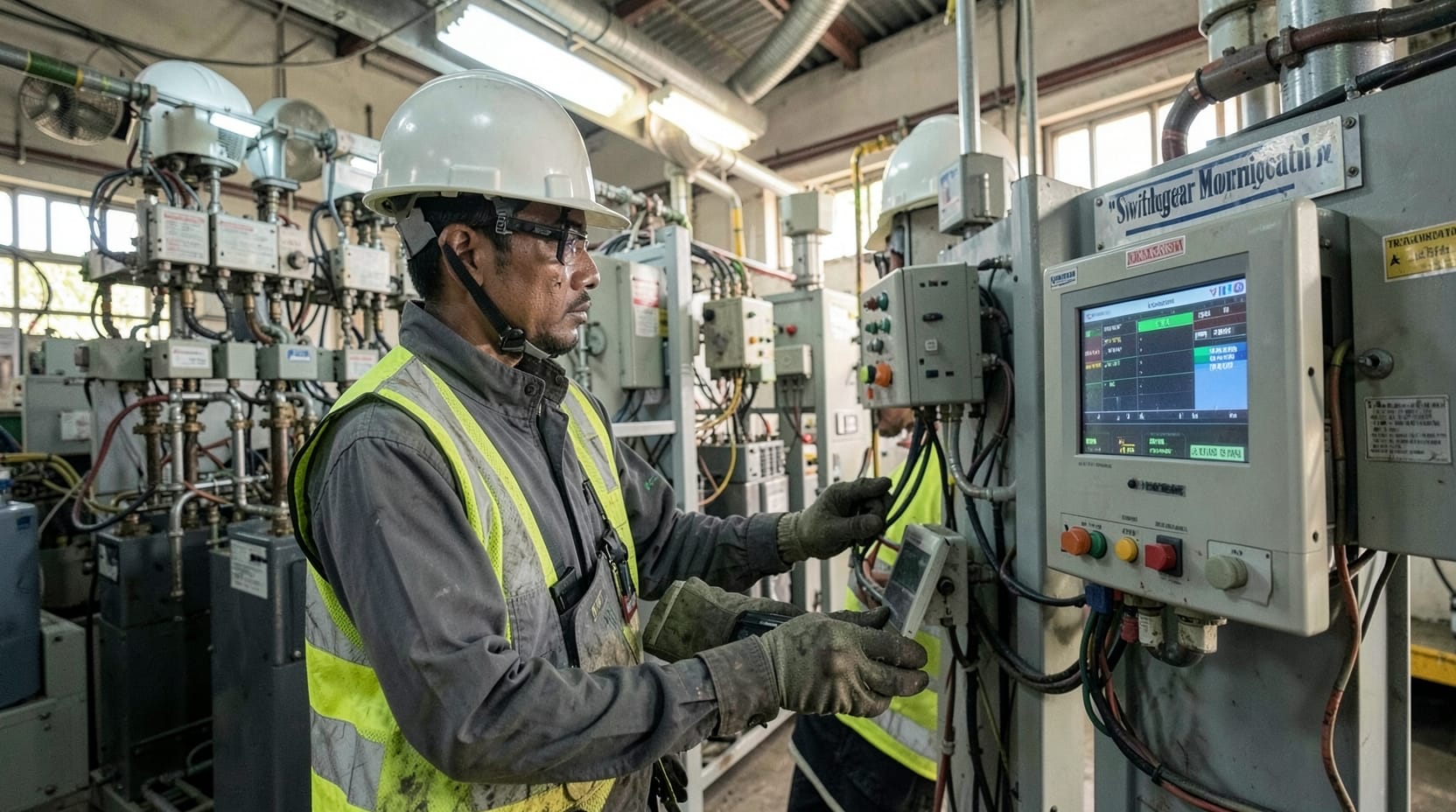
Route-based and online monitoring are complementary, and the split should follow the P-F interval and the criticality of the asset. Short warning windows and high consequence push toward continuous online monitoring; long warning windows and moderate consequence suit a route. Most mature programmes run both, with the online system reserving its capacity for the machines that justify it.
Either way, the output path is the same. A finding must reach the maintenance planner as a work request with enough information to schedule it: which machine, what is wrong, how urgent, what has to be done, and what skill and parts are needed. Planning and scheduling is where the value of monitoring is monetised, because work discovered early can be planned into an existing window instead of forced into an emergency shutdown. A monitoring programme that does not connect to planning is donating its findings to the next failure.
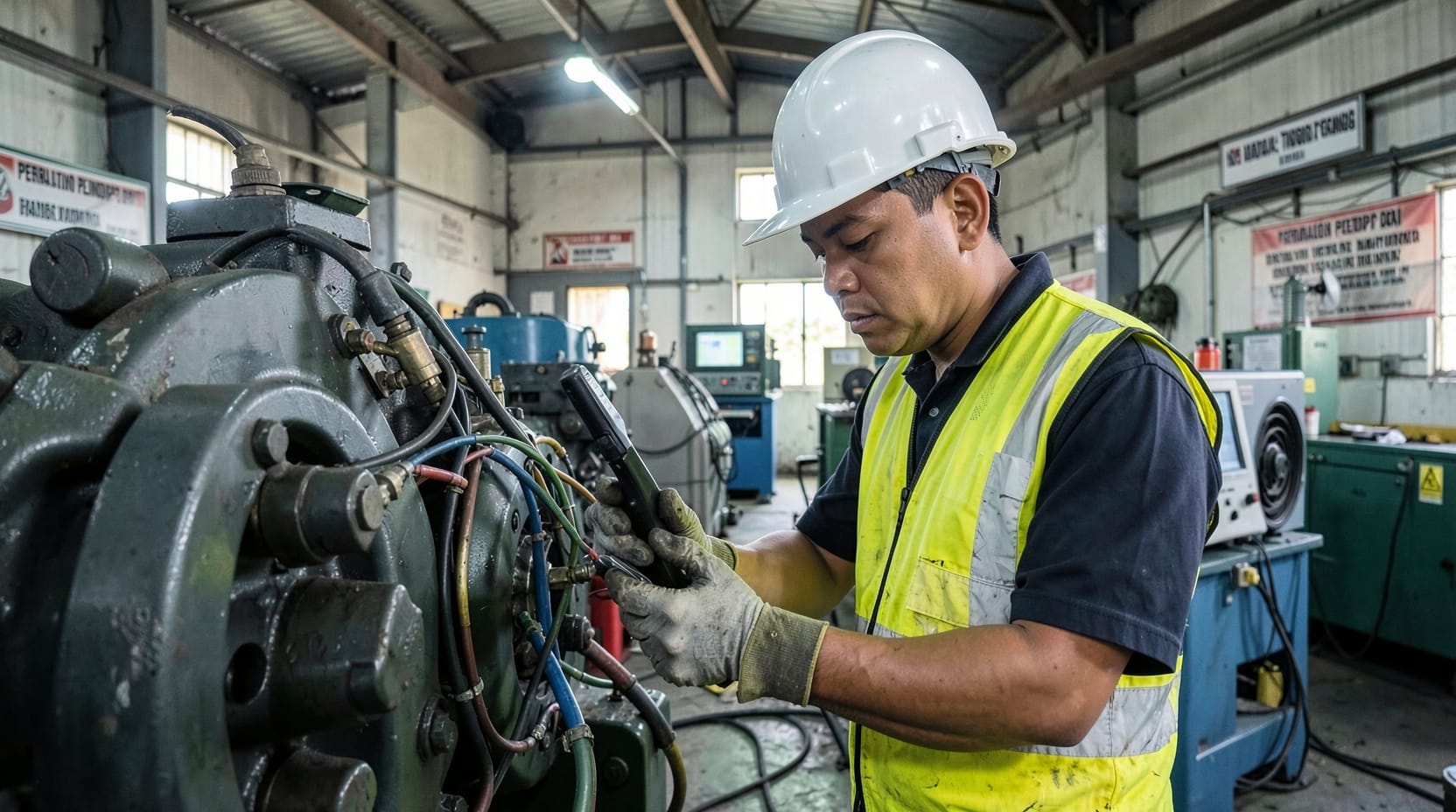
The U.S. Department of Energy‘s industrial operations and maintenance material describes condition based monitoring as a core element of a reliability-centred strategy.
Practitioner reporting in Plant Engineering regularly documents how plants structure condition monitoring programmes and the results they obtain.
Analyst certification for condition monitoring techniques is delivered against the ISO 18436 framework by training bodies such as the Mobius Institute.
Key Takeaways
- Condition based monitoring is defined by its decision loop, not by its instruments.
- Design from failure modes: each measurement point should exist because it detects a specific mode.
- Set frequency from the P-F interval, generally using one third to one half of it.
- Alarm bands must carry an agreed action, an owner, and a response time.
- A finding that does not become a work request in the planning system has not delivered anything.
- Measure the programme itself — planned catches, unplanned surprises, and false alarm ratio.
Frequently Asked Questions
What is condition based monitoring in simple terms?
Condition based monitoring means deciding when to repair equipment by measuring how it is actually behaving, instead of following a fixed calendar or a running-hour count. You measure a physical quantity that changes as the machine deteriorates, compare it to what is normal for that machine, and act when the change indicates a developing fault. The benefit is that maintenance happens when it is needed: early enough to prevent failure, late enough to use the full life of the component.
What is the P-F interval and why does it matter?
The P-F interval is the time between the first point at which a developing failure can be detected and the point at which it becomes a functional failure. It sets the required monitoring frequency: if the interval is long, a monthly route may be adequate, and if it is short, continuous monitoring is the only way to catch it. The practical rule is to inspect at least two or three times within the P-F interval so a developing fault cannot slip between inspections.
Which condition monitoring technology should we start with?
Start with the technology that covers the failure modes of your most critical equipment, which for most rotating machinery is vibration. Thermography is usually the second priority because it covers electrical distribution and is inexpensive to apply. Tiaravib’s condition based monitoring service routinely begins with a criticality ranking and a failure mode review, because the right starting technology depends on what actually fails at your plant, not on a generic ranking.
How is condition based monitoring different from predictive maintenance?
Condition based monitoring is the measurement and decision layer; predictive maintenance is the broader strategy built on it. CBM tells you what the equipment condition is and when action is required, while a predictive maintenance programme combines that information with failure mode analysis, planning, spares strategy, and performance measurement to reduce unplanned downtime. In practice the terms overlap heavily, and CBM is best understood as the practical engine inside a predictive maintenance programme.
How many measurement points should a CBM programme cover?
There is no target number. Coverage should follow criticality, and the programme should cover every failure mode whose consequence justifies the cost of detecting it. A common practical approach is to monitor a small group of critical machines thoroughly, both online and by route, extend route-based coverage to the wider fleet of important machines, and leave non-critical, low-cost, redundant assets on run-to-failure.
Can condition based monitoring be outsourced?
Yes, and for many sites it is the faster route to a working programme because it brings analyst capacity and established procedures immediately. The site keeps ownership of the data, the machine register, and the decision loop, while the provider supplies specialists, instruments, and reporting. What should not be outsourced is the response to a finding — the decision to act and the planning of the work remain with the plant.
For a condition based monitoring programme review or pilot proposal, contact Tiaravib via WhatsApp +62 821-1378-3727 or info@tiaravib.com.
Related reading on the Tiaravib site: condition based monitoring service, TRM remote monitoring, about Tiaravib and the reliability blog. External references: the Mobius Institute vibration analysis certification body.